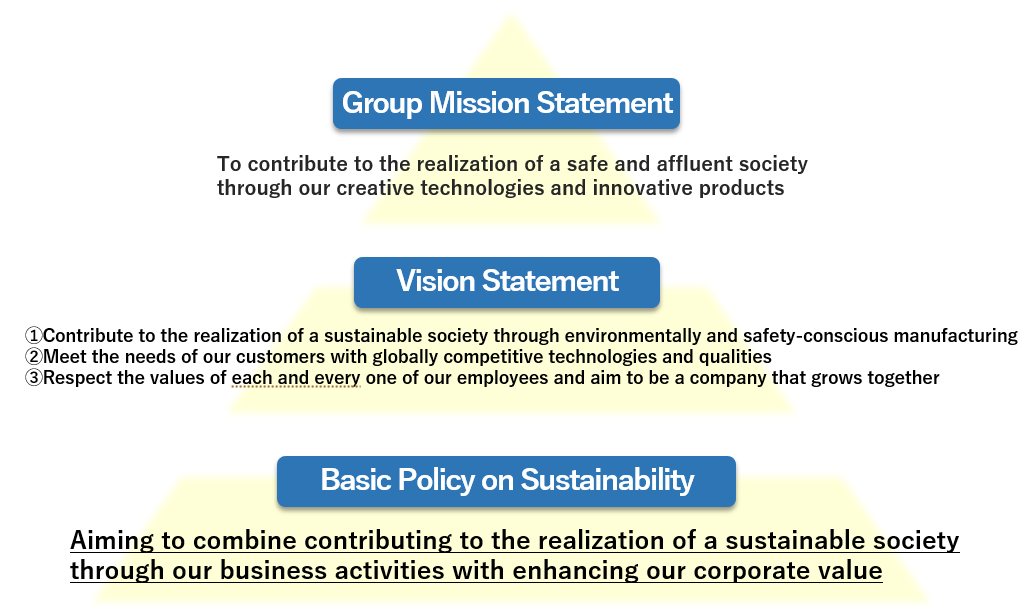
OSAKA SODA Group set its Basic Policy on Sustainability as we aim to combine contributing to the realization of a sustainable society through our business activities with enhancing our corporate value based on the Group Mission Statement of contributing to the realization of a safe and affluent society through our creative technologies and innovative products. Based on this policy, we have identified four material issues: “providing social value through business,” “strengthening business foundations,” “strengthening CSR activities,” and “developing human resources.”

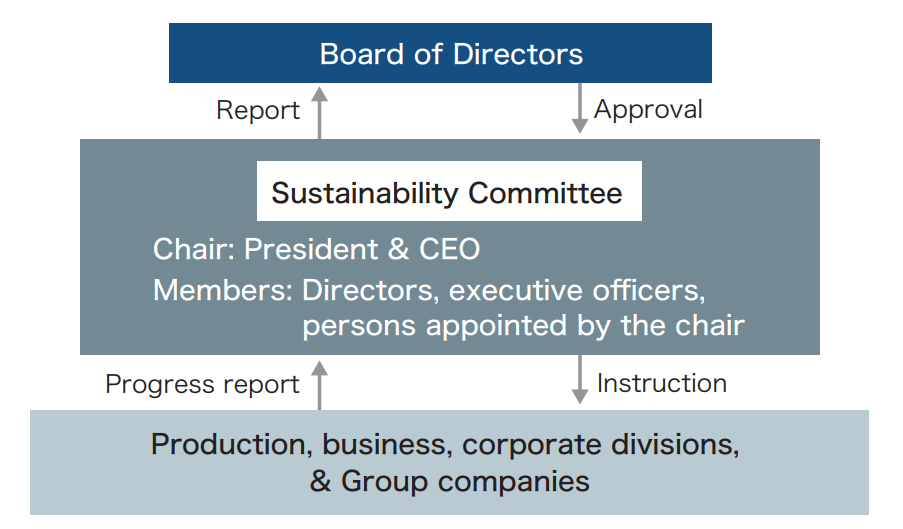
The Company has established a Sustainability Committee under the Board of Directors and built a structure for receiving reports and overseeing sustainability matters. The Sustainability Committee, chaired by the President and CEO and composed primarily of directors and executive officers, formulates policies, strategies, and initiatives; monitors and manages progress and KPI achievement across divisions and the four material issues; and provides regular reports and recommendations to the Board of Directors.
Under the material issue of “providing social value through business,” the Group aims to become a corporate group capable of sustainable growth. We seek to contribute to a sustainable global environment across all of our corporate activities by strengthening existing businesses and building competitive advantages through new product development. Looking ahead, in the four priority fields of Environment and Energy, Mobility, Information and Communication, and Health and Healthcare, which are expected to grow, we aim to help solve social issues and create new growth opportunities by developing new global niche top products. For “strengthening business foundations,” we are working to build a robust business base by ensuring stable production, improving product quality, reinforcing technological development capabilities, passing down core technologies, and strengthening production facility management systems. As an initiative to address climate change issues, which is included in “strengthening CSR activities,” Osaka Soda not only identifies risks related to transitioning to a carbon-free society and risks related to the physical impact of global warming, using a 1.5°C‒2°C scenario and 4°C scenario, but also formulates response policies. An increased carbon price, other regulatory compliance costs, and increased offset credit prices are considered risks with a major impact, and there are plans to address these risks by moving forward with introducing high-efficiency equipment and rationalizing production processes. We consider strengthening support for developing and introducing environmentally friendly technologies as an opportunity with a major impact, and will respond by developing materials that reduce environmental impact and conserve energy through improved energy efficiency, extended service life, and elimination of solvents. Turning to “developing human resources,” we aim to contribute to the growth of society and the Group by incorporating the values of diverse people and creating a work environment in which each and every employee feels job satisfaction. Our human resource development policy is to ensure that all employees can thrive and envision their future career paths so that they can work with peace of mind over the long term. To achieve this, we are reviewing our HR systems and education and training systems, fostering a workplace culture that supports diverse work styles, and developing a work environment where diverse personnel respect one another and can succeed together.
For risks and opportunities, the relevant divisions discuss and identify Company-wide risks and opportunities, evaluate them, and determine which are material. Each division and organization formulates response policies for the identified risks and opportunities. These response policies are discussed by the Sustainability Committee and then reported to the Board of Directors. The Board of Directors actively discusses the reported risks and opportunities and resolves on response policies as well as the formulation of related strategies and initiatives.
We are advancing KPIs and concrete initiatives for the four material issues and eight key elements defined under our Basic Policy on Sustainability.For more details, please refer to the link below.